
Kira Stellato – Health psychologist, expert in mindfulness and neuroscience, Dharma Psychology
I don’t know if it happens to you too, but recently I get non-stop messages, alerts, requests, night and day. We live in a world that never sleeps. A 24-hour connected world that pushes us to respond immediately, to be up-to-date, present, responsive. A world in which artificial intelligence also offers us support, but at the same time contributes to a new form of stress: cognitive hyperconnectedness.
Stopping, today, is a subversive act. And deeply human.
What happens to our brains when we are always connected?
Every notification, every visual or auditory stimulus, every demand for attention activates our dopaminergic system (Volkow et al., 2011), creating a cycle of reward and expectation. The brain, accustomed to short bursts of gratification, loses the ability to focus for long periods of time and especially to be in a vacuum, in silence, in pause.
The “constant alertness” stimulates activation of the amygdala and sympathetic system (McEwen, 2007), with long-term effects on mood, sleep, memory, and the immune system. The silent invasion of AI into our communication flows, if not consciously managed, amplifies this load: everything seems faster, more accessible, more urgent.
The guilt in stopping
Added to this is a deep psychological mechanism: guilt in interrupting the flow.
Many people, especially women, caregivers, health and helping professionals, internalize the idea that “stopping is selfish,” “slowing down is for weak people,” and “not responding right away is a sign of disinterest.”
These social narratives sediment and become part of our default mode network (Raichle, 2015), active in moments of rest, but also laden with self-judgment.
Mindfulness, slowness and ecological practices of attention
Hyperconnectedness does not act as positive reinforcement; on the contrary… The continuous alert mode of our nervous system, depletes our capacity for attention and reflection. Mindfulness teaches us that stopping is anything but selfish: it is an act of lucidity. In that emptiness we so fear, we begin to resent the body, recognize emotions, and inhabit our minds with less judgment.
Stopping is also a form of ecological resistance: against attention pollution, against content bulimia, against the idea that we are only worthwhile if we produce.
It is not escape. It is return. It is not slowness. It is rootedness.
What can we do today?
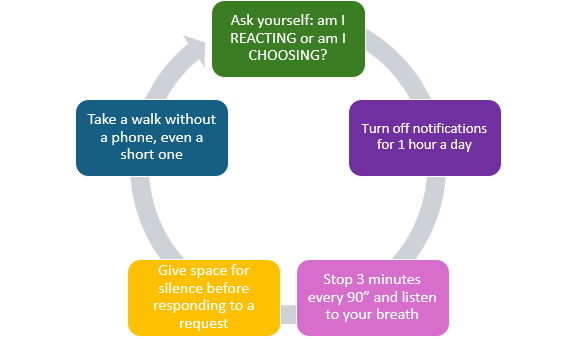
So, to recap:
- Turn off notifications for 1 hour a day. Stay with your anxiety, watch the mind flee here and there, like a mouse looking for the exit. Bring your attention back to the world.
- Stop 3 minutes every 90 and listen to the breath, without changing it. Use a timer if you need to.
- Give space for silence before responding to a request. Enjoy the mental pause that offers clarity.
- Take a walk without a phone, even a short one. Observe the details of your path. Lose yourself.
- Ask yourself: am I reacting or am I choosing? The question of true awareness.
Bibliography
- McEwen, B. S. (2007). Physiology and neurobiology of stress and adaptation: central role of the brain. Physiol Rev, 87(3), 873-904.
- Raichle, M. E. (2015). The brain’s default mode network. Annu. Rev. Neurosci., 38, 433-447.
- Volkow, N. D., Wang, G. J., Tomasi, D., & Baler, R. D. (2011). The addictive dimensionality of internet and digital media use. JAMA, 306(10), 1142-1143.
Do you want to go deeper? I invite you to follow the weekly column “The Thread of the Mind” and the new upcoming episodes of the Kira & Kai podcast. Each week, a thought that breathes with you.