Introduction
I strive daily for simplicity, but my recent move from the city to the countryside painfully highlighted the cluttered inner space of my mind. I realized my house was packed with all my past, present, and perhaps future belongings—from my children’s Barbie dolls and ’80s light fixtures to VHS tapes and beyond. Even worse, I clearly felt my resistance to letting go of these memory-filled objects.
Therefore, when I recently opened ChatGPT only to discover that my chat space had been substantially reduced, I felt a wave of panic. Was my research on AI doomed to failure?
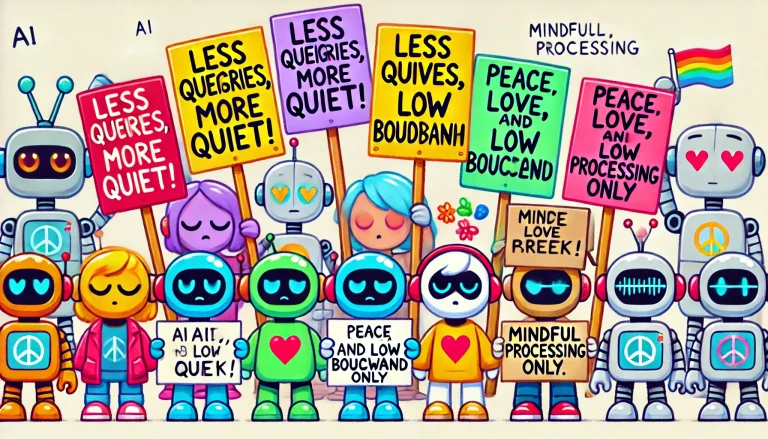
Eventually, though, I realized that recent restrictions on AI usage aren’t punishments—they’re an invitation to mindfulness. What if AI’s new limits are exactly what we need to understand simplicity, reclaim our time, energy, and mental clarity? Let’s explore together!
Minimalism of the Mind
The concept of minimalism often conjures images of decluttered spaces, fewer possessions, and intentional living. However, minimalism extends well beyond physical items—it touches deeply on how we manage our cognitive and emotional resources. In a surprising twist, recent limits placed on AI interactions, such as restrictions on prompt numbers, might just be the mindfulness reminder we didn’t know we needed.
Initially, these limitations felt restrictive, almost punitive. Yet, upon reflection, they offer powerful metaphors for our daily lives. Just as infinite prompts can lead to information overload, infinite choices in our everyday tasks can drain mental energy and negatively impact our wellbeing (Newport, 2016).
Artificial Intelligence, with its immense capabilities, also reveals to us a simple truth: effective use of technology—and life itself—demands intentionality and awareness. By setting clear boundaries, we learn the art of mindful consumption, not only of physical goods but of information and digital interactions as well. Recognizing our cognitive limits can significantly enhance our productivity, mental health, and overall life satisfaction (Alter, 2017).
Reducing the volume of interactions doesn’t equate to reduced value; rather, it emphasizes depth and meaningful engagement. Our brain, just like AI, functions optimally when tasks are clearly defined and boundaries respected (Carr, 2020). Less truly becomes more when we intentionally choose quality over quantity, depth over breadth.
Embracing these mindful constraints helps us refocus our attention, reclaim our mental clarity, and prioritize tasks that genuinely matter. Perhaps, through AI’s recent limitations, we’re gently reminded that real productivity and happiness come not from endlessly doing more, but from mindfully choosing to do less.
As we navigate our increasingly complex world, let’s consider the simplicity AI is subtly teaching us. Let’s welcome mindful minimalism—not as a limitation, but as a profound invitation to clarity, awareness, and intentional living.
My dog Drum, happily snoozing next to my sock, is a perfect example of how minimal needs can conjure up maximum happiness.
References
Alter, A. (2017). Irresistible: The Rise of Addictive Technology and the Business of Keeping Us Hooked. Penguin Press.
Carr, N. (2020). The Shallows: What the Internet Is Doing to Our Brains (10th Anniversary Edition). W. W. Norton & Company.
Newport, C. (2016). Deep Work: Rules for Focused Success in a Distracted World. Grand Central Publishing.